ESTONIA · PARCEL-LEVEL DILIGENCE
Value Estonian land and forest, and defend the number
EMPI scores productivity by strategy, values forest on Estonian empirical growth-and-yield models, tests fair value against your target return, and flags ownership and sanctions risk. Every output carries its dataset versions, model hash and run timestamp, so an investment committee can reproduce the figure.
Request a demo See the methodology
MARKET CONTEXT
Why Estonian land is on the institutional radar
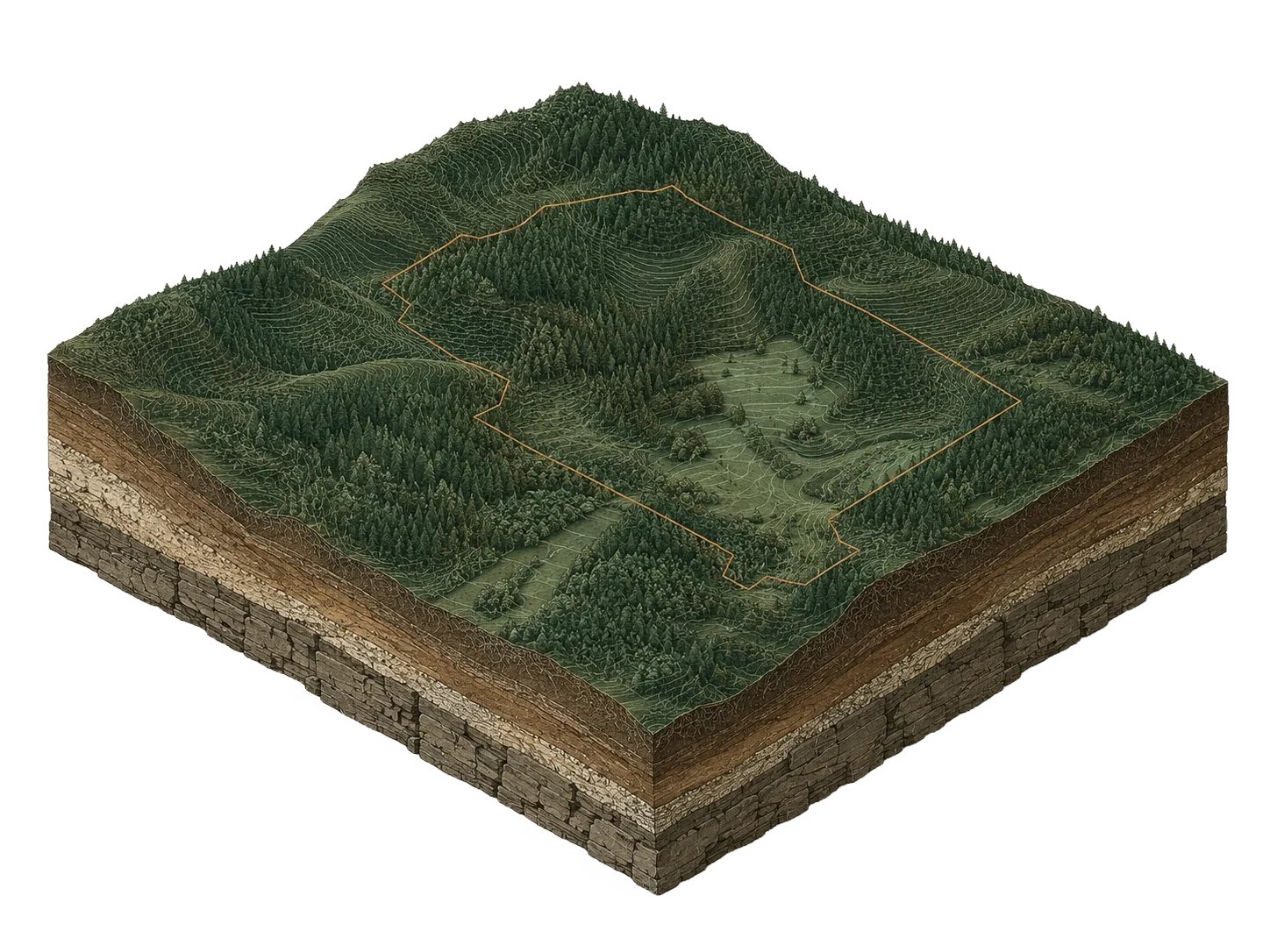
Estonia is one of the most forested countries in Europe, with a transparent cadastre, a national forest inventory running since 1999, and official transaction registers maintained by the state land and spatial board, Maa- ja Ruumiamet (formerly Maa-amet). For an institutional buyer, the raw ingredients of defensible diligence exist, but most of them are published only in Estonian, and most valuations on the market never touch them.
Birch, pine and spruce dominate the standing stock; 18.4% of forest land is under strict protection, and that fact moves valuations.
The largest recent signal of institutional appetite for Baltic timberland; INVL and Redgate run dedicated Baltic funds.
Estonia’s ~€1bn direct-payment plan and EU external convergence sit structurally under arable values.
Convergence headroom is real; so is boom-cycle risk. EMPI’s own methodology warns the boom-decade growth rate cannot be extrapolated.
The institutional case is live, but it is a case for diligence, not enthusiasm. Prices ran hard through 2019–2024, the market is thin in places, and a parcel’s legal restrictions can quietly remove most of its productive value. That is the problem EMPI was built to measure.
SCORING METHODOLOGY
One parcel, one passport, never one score
A single composite score hides exactly what an investment committee needs to see. EMPI reports every parcel as a production-capability passport with three separate layers: what the land can biophysically produce, what it may legally be used for, and what is economically useful after restrictions and access are priced in.
On top of the passport sits a panel of strategy-specific suitability scores on a 0–100 scale: agricultural use, grassland, existing forestry, afforestation, restoration and conservation, climate-resilience baseline, restriction severity, and uncertainty. A parcel that scores well for afforestation may fail for agriculture; the panel shows both instead of averaging them away.
No score is ever shown without a verification status. EMPI’s eight-level taxonomy runs from verified at high confidence (decision-ready) down to rejected when access is blocked, so an analyst always knows whether a number is decision-ready or needs legal review or a field visit first.
Illustrative example, not a live parcel.
Scoring weights are versioned configuration; the methodology document changes before the code does. Full decomposition: methodology page. How the scoring works

See the passport run on a parcel you are actually looking at.
FORESTRY ECONOMICS
Forestry economics, Estonian-empirical
Generic growth curves mislead buyers in Estonia. EMPI’s forestry DCF is anchored on Estonian-empirical growth-and-yield models (v1.0.0): Kangur’s 2007 Scots-pine model, an Estonian allometric stack for six further species, and Hossfeld IV site indices per Tammiste 2021, cross-checked against the National Forest Inventory, where 5 of 6 species pass within ±25% (EMPI G&Y validation, 2026).
Rotation ages follow the Estonian Forest Management Regulation and Forest Act §29 by species and site index. The model harvests when the law allows, not when a spreadsheet finds it convenient. Where protection regimes overlap a stand, a harvest-restriction factor scales timber cashflows: 0.00 under strict protection, 0.50 in water-protection zones, 0.85 under Natura 2000. The land’s resale terminal value is never scaled. Restricted forest can still hold land value even when timber value goes to zero.
Talk to us about a parcel Read the full valuation walkthrough

| Strategy | 3% | 5% | 8% | 12% |
|---|---|---|---|---|
| Existing forestry | Pass | Pass if timber verified | Marginal | Overpriced 2× |
| Afforestation | Pass | Marginal | Marginal | Overpriced 2× |
| Agricultural use | Marginal | Marginal | Overpriced 2× | Overpriced 2× |
Illustrative example, not a live parcel.
COMPLIANCE & PROVENANCE
Compliance that flags, never decides
Estonian land deals close against a hard regulatory backdrop: MONEYVAL’s 2022 evaluation flagged gaps in beneficial-ownership data quality, with e-resident and corporate-service-provider structures named as elevated risk factors (FATF/MONEYVAL, 2022). EMPI resolves the ownership graph and recursive UBO chain live against the Estonian Business Register, then screens for sanctions and PEP exposure, including Estonia-specific advisory flags such as CSP-chain and e-resident-director patterns.
The boundary is absolute: EMPI raises advisory flags only. The compliance officer makes every decision. Every screening run is recorded in an append-only audit trail, and every output carries a reproducibility provenance envelope: dataset versions, model-weights hash, code commit, run timestamp, and config versions. Outputs without it fail closed.

Provenance envelope
Illustrative example, outputs without a complete envelope fail closed.

DATA BACKBONE
Built on official Estonian data
EMPI does not quote brochures. The live data backbone is built from official Estonian registers, each ingested with versioned provenance (counts from the EMPI live ingest, April 2026):
Plus the Business Register (Äriregister) for ownership and the EU consolidated sanctions list (15,162 entries) for screening. Comparables resolve against Maa- ja Ruumiamet’s official transactions register; detailed access to it is granted case by case, and until that access is in place EMPI reports the comparable set as insufficient rather than valuing off thin data. The full data backbone
Every figure traces back to these datasets, with versions and a run timestamp.
Request a demo How screening and provenance work
Single-tenant. Engagement starts with a conversation.
FAQ
Questions institutions ask
EMPI, Estonia Land Productivity Intelligence, is a land and forest investment-diligence platform for Estonian agricultural and forestry parcels. It delivers productivity scoring, Estonian-empirical forestry DCF valuation, comparables-based fair value, and ownership, UBO and sanctions screening, with every output carrying a full reproducibility provenance envelope.
No. EMPI is analytical decision support. It reports what a parcel can produce, what is legally restricted, and what a buyer pays per useful square meter versus fair value at chosen target returns. It never recommends buying or selling, and it makes no return promises.
No. EMPI raises sanctions, PEP and UBO advisory flags; the fund’s compliance officer makes every decision. Estonia-specific flags cover CSP chains, e-resident directors and UBO-declaration freshness. Every screening run is recorded in an append-only audit trail kept as regulatory evidence under the Estonian AML act.
With a discounted-cash-flow model built on Estonian-empirical growth-and-yield curves (Kangur 2007, Hossfeld IV site indices per Tammiste 2021), rotation ages anchored to the Estonian Forest Act, and a harvest-restriction factor for protected forest. The models are cross-checked against the National Forest Inventory.
Official Estonian sources: the Maa-amet cadastre, Maa- ja Ruumiamet transactions (detailed access granted case by case), EstSoil-EH soil data, EELIS protected areas, PRIA LPIS, the Forest Register, the Business Register (Äriregister), Statistics Estonia and Copernicus elevation, plus cited Estonian forestry science. Every output records exactly which dataset versions it used.
Because a parcel is good for one use and not another. EMPI separates biophysical, legal and economic productivity, and scores each strategy on its own 0–100 scale, so a buyer sees exactly where value and risk sit, instead of an average that hides both.
No. EMPI is a single-tenant, internal-grade analyst workbench, there is no public signup, no subscription tier and no pricing page. Engagement starts with a conversation: request a demo, a methodology briefing or a research-partnership discussion through the contact form.
Yes. Every output is stamped with dataset versions, a model-weights hash, the code commit, run timestamp and config versions; outputs without this provenance envelope fail closed. The screening and analysis history is append-only, records are never updated or deleted.
Research & field notes
Evidence-led notes from the research log behind EMPI: Estonian land markets, forestry economics and the data underneath.

Estonian forest carbon stock has fallen for seven straight years
Estonia's forest carbon stock peaked in 2017 and has fallen every year since, down 6.5%. Which species carry the decline, and what it means for a buyer.

Standing timber or forest land: what a buyer is actually paying for
Standing timber and forest land are two assets in one transaction. How to separate them, how much wood a hectare carries, and what that does to the price.

Forest site index in Estonia: what boniteet is and why it sets the price
Site index, boniteet, is an Estonian forest productivity class from IA to V. It sets rotation age, 90 to 120 years for pine, and so it sets parcel value.

Estonian arable land rent: what it earns, and what that implies
Estonian agricultural land rented for 115 euros a hectare in 2024. Rent rose 448% since 2009 while the price rose 996%, halving the gross yield to 1.70%.

Estonian forest notification: rules, timing and what it costs
An Estonian forest notification is filed before cutting: 15 working days to review, valid 24 months, 30 euro fee on regeneration felling. What it means.

Estonia’s 2025 felling collapse: private forest did all of it
Felling fell 24.3% in 2025 to its lowest level since 2010. State forest barely moved and private forest took the entire drop. The county split, and what it changes for a buyer.

Estonian arable land: what the price is, and what the land earns
Arable prices fell in 2025 for the first time in fifteen years, and the two official series disagree on by how much. What a hectare earns, how much of that is subsidy, and whether the price is supported.

Estonian forest land: the institutional investment case
Estonia is ~51.5% forest and institutional capital has moved (Ingka’s €720m Baltic deal). Sourced data on Estonian forest-land prices, ownership and why diligence decides outcomes.

How to value forest land: a growth-and-yield DCF walkthrough
From site index and rotation age to discounted timber cashflows and land terminal value, the Estonian-empirical way to value a forest parcel, and why generic curves mislead buyers.

Protected forest in Estonia: how restrictions change parcel value
18.4% of Estonian forest is under strict protection. How Natura 2000, water-protection zones and strict-protection regimes scale harvest cashflows, sometimes to zero, and what that does to fair value.
CONTACT
Talk to us about a parcel, a mandate, or the methodology
EMPI is single-tenant and engagement starts with a conversation. Tell us what you are looking at, and we will walk you through a real parcel passport end to end: the score panel, the forestry DCF, the fair-value matrix and the provenance envelope.
- Private demo A full parcel-passport walkthrough for funds and family offices.
- Methodology briefing The scoring decomposition and Estonian-empirical G&Y, for analysts.
- Research partnership For universities and data partners working on Estonian land productivity.
Prefer email? info@empi.ee
We reply personally. EMPI is single-tenant, and engagement starts with a conversation.